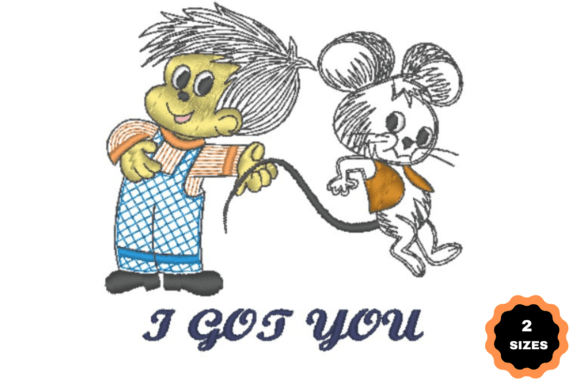
Boy Caught the Mouse
A Practical Embroidery Designer’s Review for Small Business Merchandise
As an embroidery designer who’s developed hundreds of commercial designs for cafés, boutiques, pet brands, florists, and handmade studios, I approach every new machine embroidery design with two questions: Does it translate clearly at real-world sizes? and Does it strengthen—rather than distract from—a brand’s voice? When I first saw Boy Caught the Mouse, my instinct was to pause. The title evokes whimsy, narrative, and gentle charm—not flashy or corporate, but warmly human. That’s a powerful starting point for small business merch, where authenticity and approachability drive customer trust.
First Impression: Playful, Handmade, and Professionally Balanced
Boy Caught the Mouse reads as a friendly, story-driven embroidery file—neither overly cutesy nor stiffly formal. It leans into the handmade product aesthetic without sacrificing polish, making it ideal for businesses that want to signal care, craft, and personality. Think: a neighborhood bakery stitching it onto aprons, a children’s bookshop using it on tote bags, or a pet-friendly café embroidering it onto staff caps. Its tone aligns well with the Boys category—but not in a limiting way. It’s inclusive, nostalgic, and quietly confident—perfect for brands that value storytelling over slogans.
Real-World Performance Across Business Applications
In practice, Boy Caught the Mouse shines brightest as an embroidered patch or subtle chest accent. On denim jackets, canvas totes, or cotton aprons, its visual rhythm holds up beautifully—even at 2.5"–3.5" widths—thanks to clear silhouette definition and intentional negative space. As cap embroidery, it works best on structured front panels (not curved bill seams), especially when simplified into a clean outline version. For custom apparel like work shirts or uniforms, place it on left chests or upper sleeves where it reads quickly and reinforces brand identity without overwhelming function.
On product packaging accents—think embroidered tags on soap bundles or seed packet sleeves—Boy Caught the Mouse adds tactile distinction that elevates perceived value. Etsy sellers and crafters report higher engagement when this design appears in printable mockups: customers imagine it stitched onto their own creations, reinforcing emotional connection before purchase. As part of a broader set of design assets, it pairs naturally with simple typography or botanical motifs—never competing, always complementing.
Where to Use It Thoughtfully (and Where to Adjust)
Like any strong embroidery file, Boy Caught the Mouse demands thoughtful execution—not just placement. Avoid scaling it below 1.75" for patches; fine details (like facial expression or mouse texture) may blur or stitch poorly on small hoop sizes. On dark uniforms or textured fabric—such as twill work shirts or burlap totes—verify thread color contrast early. A light tan or cream thread may disappear; ivory or soft yellow often reads better. Also, test stitch density on high-wash items: if the original file includes dense fill areas, consider simplifying outlines for aprons or kitchen linens that endure frequent laundering.
Caps with deep curvature (like low-profile snapbacks) require re-digitizing adjustments—don’t assume the standard file will drape cleanly. And while the description says it’s designed for “any fabric that needs a nice accent,” remember: any doesn’t mean all. Delicate silks or stretch knits need stabilizer upgrades and slower stitch speeds. Always run a test on your actual production fabric—not just felt or muslin.
How It Shapes Brand Identity and Customer Perception
Small businesses thrive when customers feel they’re supporting people—not just products. Boy Caught the Mouse subtly communicates warmth, curiosity, and quiet confidence. Unlike generic icons or stock symbols, it invites a micro-story: Who is the boy? What kind of mouse? Is it mischief or wonder? That narrative resonance builds recognition across touchpoints—from Instagram posts showing embroidered tote bags to in-store signage featuring the same motif.
Used consistently, it becomes part of your visual shorthand. A florist uses it on staff aprons and gift tags. A toy shop features it on reusable shopping bags and employee name badges. Over time, customers begin to associate that gentle, character-led energy with your brand—deepening loyalty and differentiating you from competitors relying on fonts or clipart. That’s the power of intentional embroidery: it transforms functional items into branded experiences.
Essential Designer Notes Before You Stitch
- Test in black and white first. This reveals balance, spacing, and legibility—especially important for multi-color versions.
- Check minimum viable size. Does Boy Caught the Mouse retain clarity at 2" wide? If not, request a simplified variant or adjust manually.
- Review thread color contrast against your base fabric—on-screen previews lie. Print a physical swatch.
- Inspect spacing between elements. Tight loops or overlapping shapes can cause thread breaks or nesting issues in commercial embroidery.
- Confirm hoop size compatibility with your machine and frame setup—especially for larger versions used on tote bag designs.
- Use appropriate stabilizer. Tear-away for stable wovens, cut-away for knits, and heavy cut-away for high-stitch-density sections.
- Create a client-approved mockup before bulk production—digital embroidery files are easy to tweak; stitched errors cost time and trust.
- Compare it beside other design assets. Does Boy Caught the Mouse harmonize with your logo, palette, and typography—or does it visually compete?
- Verify commercial licensing. Since this is marketed as a machine embroidery design for “small business merchandise and branded patch use,” confirm permissions cover your intended use—especially for resale items or digital mockup distribution.
Ultimately, Boy Caught the Mouse isn’t just another embroidery file—it’s a versatile, emotionally intelligent tool for small business owners building something meaningful. Used with intention, it supports brand identity, enhances product value, and invites customers into a world that feels both crafted and kind. Whether you're stitching it onto a barista’s apron or a handmade toy’s label, remember: the strongest merch doesn’t shout—it smiles, remembers, and stays stitched in the mind long after the thread fades.